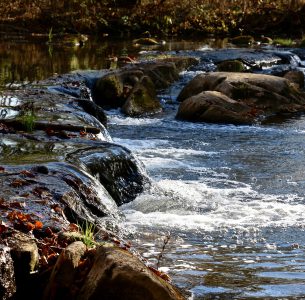

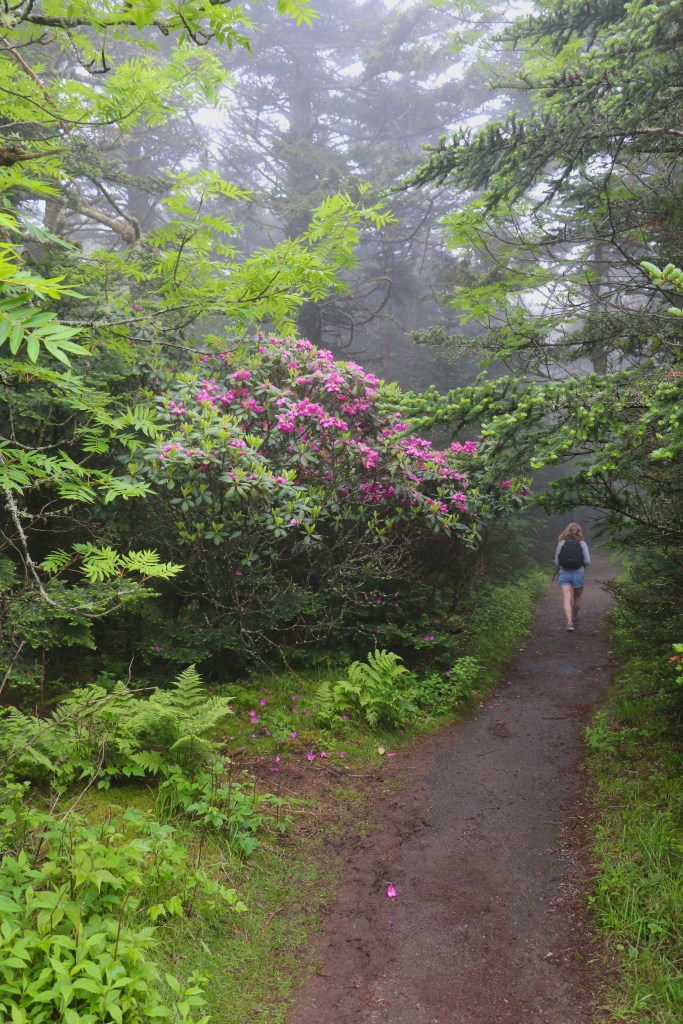
During a recent visit to Roan Mountain, my wife and I hiked the short trail to Roan High Bluff. This trail begins just a few hundred yards down the gravel road from the rhododendron garden parking area. The day we visited, most of the trail was shrouded in a thin cloud cover that gave the woods an otherworldly feel. The deep greens of spruce and fir trees, mosses, and the waxy rhododendrons with their rich pink blossoms were all surrounded by a soft, gray exhale of the sky.
When we reached the wooden observation platform at the bluff, the clouds thickened and completely obscured the vista that looks out west over the valley and the tiny community of Buladean, NC. While we couldn’t “view the view,” we could just make out the spruce trees on either side of the platform. On that high, rocky bluff, prevailing westerly winds have had a remarkable effect on the trees. The west-facing side of the trees have very short, stubby limbs because strong and continuous breezes rising from the warmer valley have pushed and bent the trees on the windward side, prohibiting their limbs from growing as genetics would otherwise determine. This affects only the most exposed trees. Even the second-row trees grow more “normally” than those immediately in front of them.
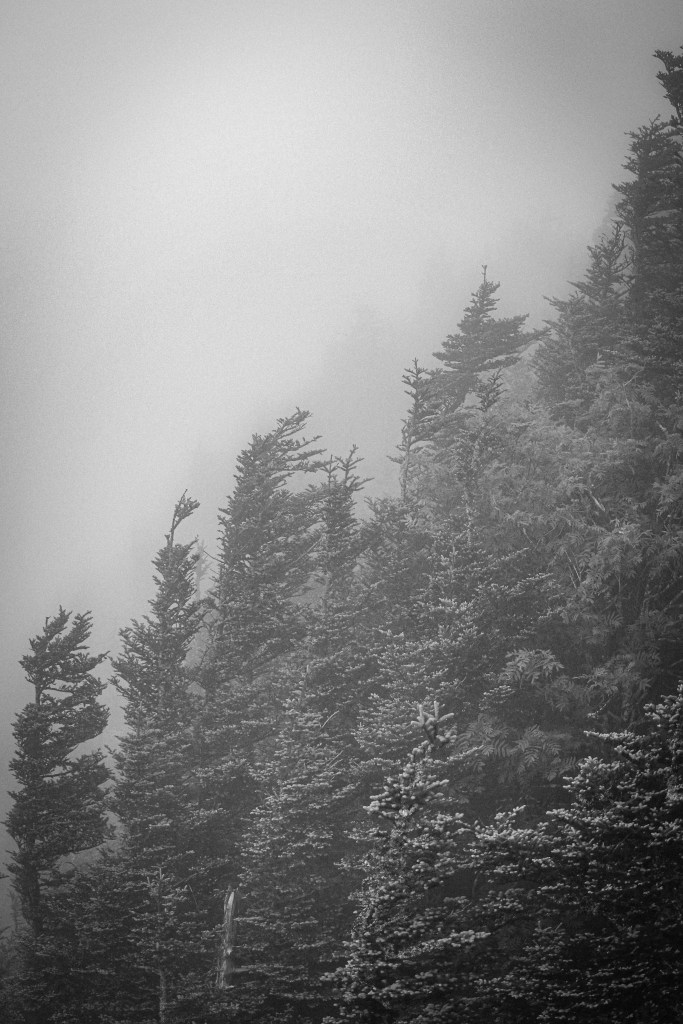
The front-row trees reminded me of parents huddling over children in a storm trying to protect them from sand and other flying debris, or simply trying to calm their fears.
While there may well be life beyond the earth, for billions of years, this planet has been circling the sun, and for the last 300,000 years—give or take—it has been humankind’s only home and refuge. The atmosphere huddles over us, protecting us and providing breathable air. Oceans, rivers, streams, and lakes hydrate us. Plants and animals feed and clothe us. Forests shelter us. Beauty and wonders delight us. Natural phenomena terrify us and leave us in bewildered awe.
Deeply rooted in scripture and in humanity’s connection to God through connection to one another and to the natural world, Celtic spirituality is fond of saying that the Creation (all of it!) is the “first incarnation of God.” In other words, we see, hear, and experience God in and through all that God made and called good. I think many psalmists would agree with that (Ps. 8 and 104). Isaiah and Paul would probably agree, as well. (Is. 55:12, Rom. 1:20) Unfortunately, the ancient stream of Christian spirituality that the Celts embraced was mostly forgotten as Empire co-opted the Church and coerced it to justify—theologically and morally—humankind’s exploitation of the earth and of humbler populations of human beings. God and righteousness became associated with wealth, power, and “winners.” Everyone else was fair game to be dominated and subjugated for further gain.
It’s our turn to do the huddling. It’s our turn to take better care of the earth. As the climate deteriorates the conditions that have sustained life, we face more than mere political and social issues. We face a spiritual/theological reckoning, as well.
Just how grateful are we for the earth that God has made?
When Jesus calls us to love as he has loved us, doesn’t that love mean showing both gratitude for those who came before and preemptive care for those whom we will never know?
And even if one doesn’t accept the science of climate change, isn’t it the loving, indeed the Christlike, thing to do to care for the earth while we live here?
*This piece is an adaptation of a congregational newsletter article.
 Jabbok in the Foothills