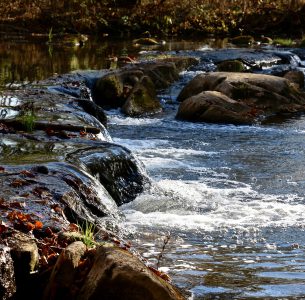

Today is July 23, 2024. On June 23, I led worship and preached for the last time as an installed pastor in the Presbyterian Church (USA). And the last four weeks have slipped by quickly—no surprise to someone who has celebrated sixty-one birthdays. As one ages, the flow of time seems to intensify the way a river’s current intensifies when the water approaches a series of rapids or a falls. It pulls with an urgency, at some point, becomes impossible to resist. Having said that, the days have not exactly hastened by, either. Since my resignation from parish ministry, I have felt the drift of time more than the frenetic, care-laden scurry to which I had become accustomed, which had become normal, and which had exhausted me.
On the morning of Monday, July 8, I was packing my motorcycle for a trip to the North Carolina mountains. A week earlier I had driven a car to the mountain house to leave some things that wouldn’t fit on my bike—my spare guitar, a stash of food, and a few other non-motorcycle-friendly necessities. Moments before leaving, my sister wheeled up in her bright red car to check in. Being a spiritual director and dream worker, she brought three books and offered them as potentially helpful for someone who has just left one career path and is entering the frontier of between time. I had already packed two books, but I looked at the three new possibilities. One just didn’t stir anything in me. The one by Parker Palmer I had read twice before. Then I scanned the table of contents of Crossing the Unknown Sea: Work as a Pilgrimage of Identity. (Riverhead Books, 2001) The book is poet David Whyte’s reflection on work and vocation. I had planned to be away only two or three nights, and with space on a motorcycle being what it is (or rather isn’t!), I replaced one of the books I’d packed with Whyte’s volume. That last-second substitution has proven wonderfully helpful.
I’m still reading Whyte’s book—slowly and deliberately. He shares many personal experiences and insights that invite his readers to sit and contemplate, to make connections in our own lives, to re-imagine ourselves and our place in the world as it changes and as we change. In one particularly moving passage, Whyte shares a conversation he has with a mentor, a monk named Brother David. After having made an unnerving but profoundly revealing mistake at work, Whyte contacted Brother David and asked him to come visit. The two men sat at Whyte’s kitchen table sipping wine, reading poetry to each other, and talking. Finally, David Whyte cut to the chase and said, “Brother David, tell me about exhaustion.”
With tremendous compassion and wisdom, Brother David looked at his friend and said, “You know, the antidote to exhaustion is not necessarily rest…The antidote to exhaustion is wholeheartedness.”
Brother David’s words and stopped me and caused me to sit in silence for a long time. “The antidote to exhaustion is wholeheartedness.”
At the farewell party my congregation held for me on the Saturday before my final Sunday, someone spoke about how “tirelessly” I had worked. When it was my turn to say a few words, I thanked the person who had made that observation. And I had to add that if I had worked tirelessly in that congregation over the last thirteen-and-a-half years, my weight of twenty-eight years of ministry had rendered me simply tired. There’s really no off button on congregational ministry. Add to that the stressors of a chaotic political climate, the complexities of leading a congregation through a global pandemic, and the questions that continuously gurgle up from one’s own personal growth and transformations, and I found myself swimming across an intensifying current and becoming more and more exhausted. It was time to lie back and allow the river to take me.
While I don’t know where the current will lead, David Whyte’s own struggle helps me to realize that I’m entering more than a metaphorical wilderness. I’m entering an entirely new kind of wildness. His conversation with Brother David also helps me to realize that, instead of praying for this job or that job, my true prayer is for a fresh, new-born wholeheartedness. I have experienced similar things before—in 1996 when I was ordained and installed in my first congregation, and again in 2002 and 2010 when I was installed in my second and third congregations. While I don’t sense a call for to a new pastorate, I do trust that it’s time for new energy, new things to experience and to contribute. It’s time for new work and new life.
A few years ago, I wrote a song with the not-so-original title of The River. The song ends with the river itself encouraging us to remember that “To be grateful, giving, and free [i.e., to experience the full liveliness and holiness of our humanity]/Is to love the River inside you, and to welcome the welcoming sea.”
May your own Rivers be trustworthy, and your Oceans deep havens of welcome and grace.
 Jabbok in the Foothills